The recovery timeline
Vegetation growth after a fire progresses in recognisable stages. Fire ecologists call these growth stages, and count them from the last fire. No stage is the “good” one. Different plants and animals prefer different growth stages, so the highest biodiversity generally comes with a mosaic of growth stages.
How long each stage lasts
How long each stage lasts depends on the vegetation, so the stages are set for each fire division (section 1.2).
| Vegetation division | Juvenile | Young | Mature | Old |
|---|---|---|---|---|
| Grassy / Heathy Dry Forest | 0–3 | 3–10 | 10–35 | 35+ |
| Forby Forest | 0–3 | 3–10 | 10–150 | 150+ |
| Inland Plains Woodland | 0–4 | 4–19 | 19–120 | 120+ |
| Treed Swampy Wetland | 0–3 | 3–8 | 8–30 | 30+ |
| Basalt Grassland | 0–2 | 2–4 | 4–6 | 6+ |
Note how different the rows are. Bush that burnt thirty-five years ago is old in Grassy / Heathy Dry Forest and barely middle-aged in Forby Forest, while Basalt Grassland is old just six years after a fire. Inland Plains Woodland rarely carries fire at all. Its stages describe what follows the unusual fire that does get through, and its 150-year maximum is only a best estimate. Some stands can be degraded by a single fire.
What you might see at each stage
| Stage | What you see |
|---|---|
| Juvenile | In the first months, black ground and then a green fuzz. Resprouters shoot, grass trees within a fortnight.2 Surviving animals are suddenly very visible.3 Then fire ephemerals carpet the bare ground and hold the soil, seedlings of the plants the fire killed appear, and bird diversity is still low. |
| Young | The shrub layer closes in. Small mammals are well down but climbing; some peak around ten years after fire.43 |
| Mature | The second generation of plants killed by the fire reaches full size and sets seed properly. Logs and litter build up, and the bush gets more varied in structure. |
| Old | Mammal populations have recovered, and this is where most hollows are. Plants that rely on fire may start dropping out. |
Why a mix of growth stages is valuable
Different animals need different stages at the same time. Young regrowth is dense at ground level, good for small mammals and low-feeding birds. Mature bush has structural variety and accumulated logs. Old bush is where most hollows are. Old vegetation is now managed as an asset in its own right on public land, precisely because it is so hard to replace.7
The state’s benchmarks for public land give a sense of balance: roughly 5% juvenile, 10% adolescent, 30% mature and 20% old, with no more than 30% of fire-sensitive types below their minimum interval. These are landscape-wide targets, not property targets.710
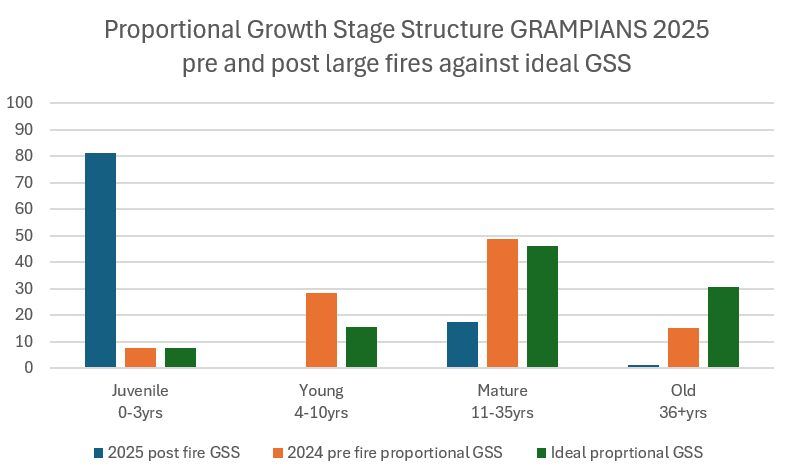
If you have recently experienced a fire, some of your block will have reset to the juvenile stage. But you may still have areas that escaped the fire, adding a diversity of growth stages to your block’s habitat.
On the Part 2 tab of the Wimmera Bushfire Ecology Lookup Tool, section 2.1, Growth stages, works out the stage of each part of your block from the years since it last burnt, based on its vegetation fire division.
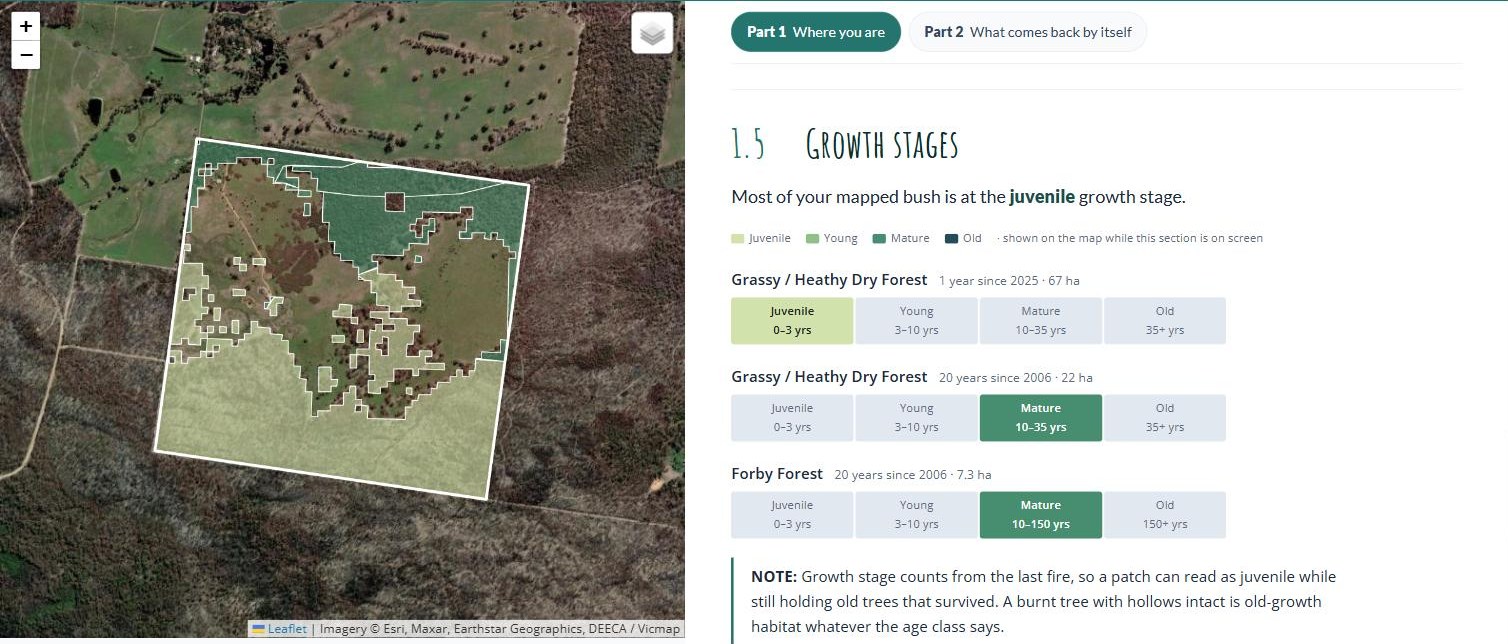
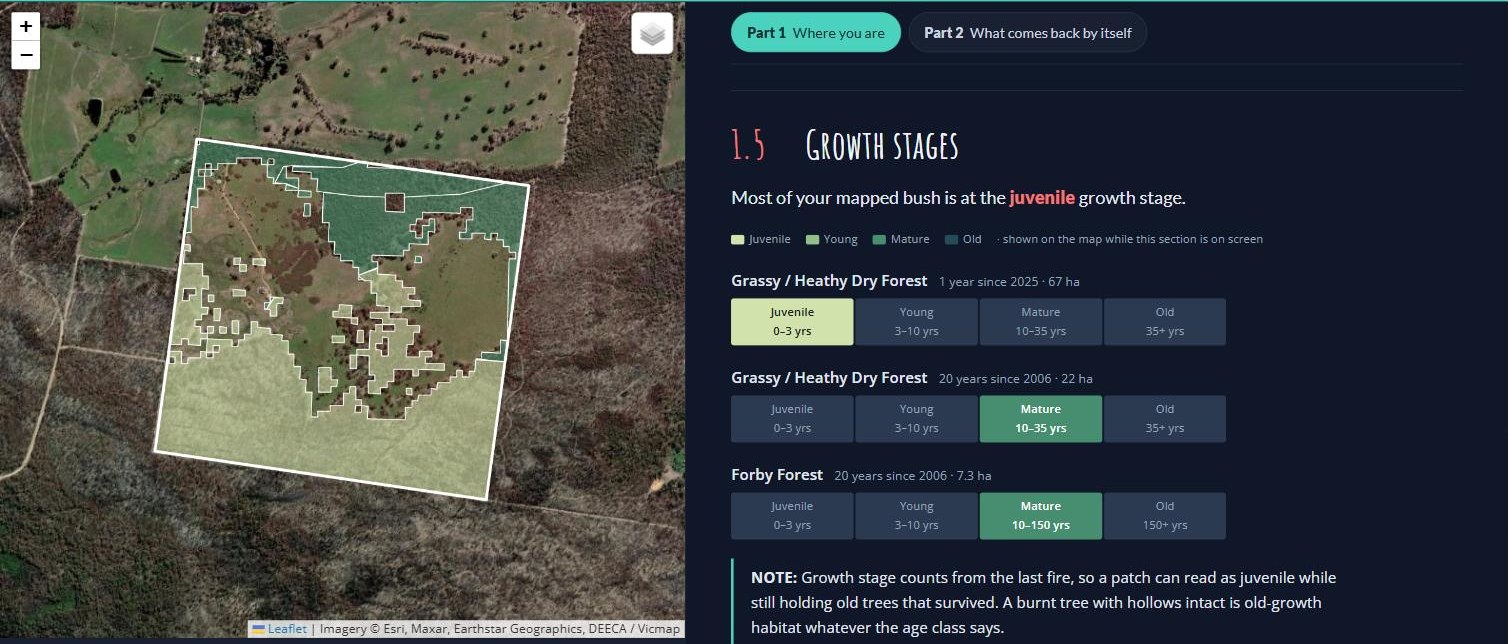
The 67 hectares of Grassy / Heathy Dry Forest that burnt in the 2025 Yarram Gap Road fire is juvenile, early in a stage that runs to three years. By its second spring, in late 2026, fire ephemerals should be carpeting the bare ground there and seedlings of the plants the fire killed should be showing. The 22 hectares that escaped last burnt in 2006, twenty years ago, so it is mature (10–35 years in its division), and the Damp Sands Herb-rich Woodland is early in Forby Forest’s long mature stage. The block now carries two stages side by side, and the older one is the scarcer: only 15% of the bush within 5 km is mature or older (Your block in the landscape, below).
Wildlife in the first few years
In the first six months you may see more wildlife than usual. That is exposure, not recovery — the survivors have nowhere to hide. Numbers usually fall from here as food and shelter run out and predators find them easy — predation pressure measurably rises once cover is gone. This is when pest control does the most good.567
Small mammals mostly come back from animals that survived the fire on the spot, in unburnt patches, logs, rock piles and burrows, rather than from animals moving in from outside.3 This is one reason why unburnt patches on your block are very important. Expect numbers to stay well down for the first few years and climb as the shrub layer thickens. Some mammals may start to return to pre-fire levels around ten years after fire, though drought after fire can continue to suppress numbers.4
After a high-severity fire, bird diversity can stay low for three years or more. Fire intensity will also affect how quickly your bird biodiversity returns. Data from the Grampians heathy woodlands showed that species returned sooner to areas that burnt patchily than to areas that burnt at high intensity.8
Drought first, then browsing pressure, then weeds. Two of the three are things you can act on.79
 Weeks
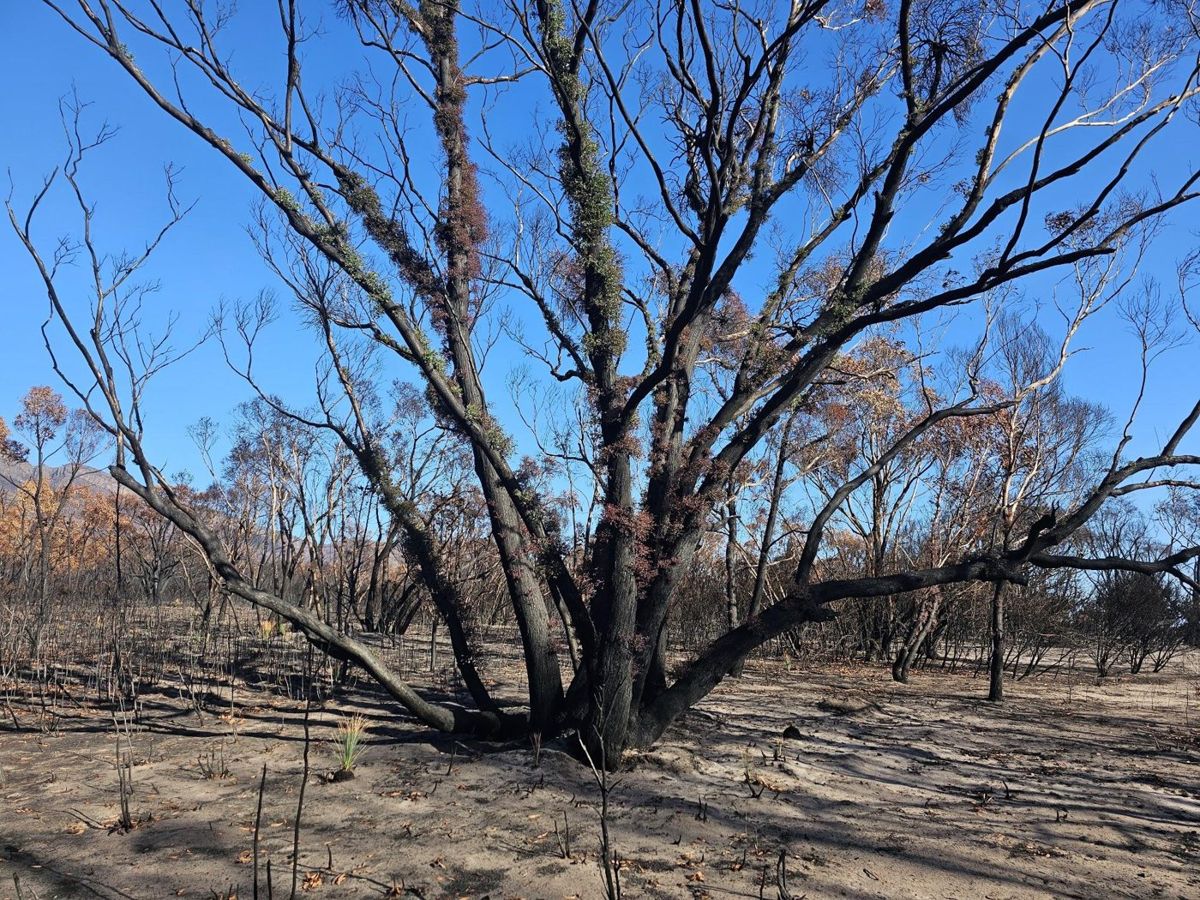 A month
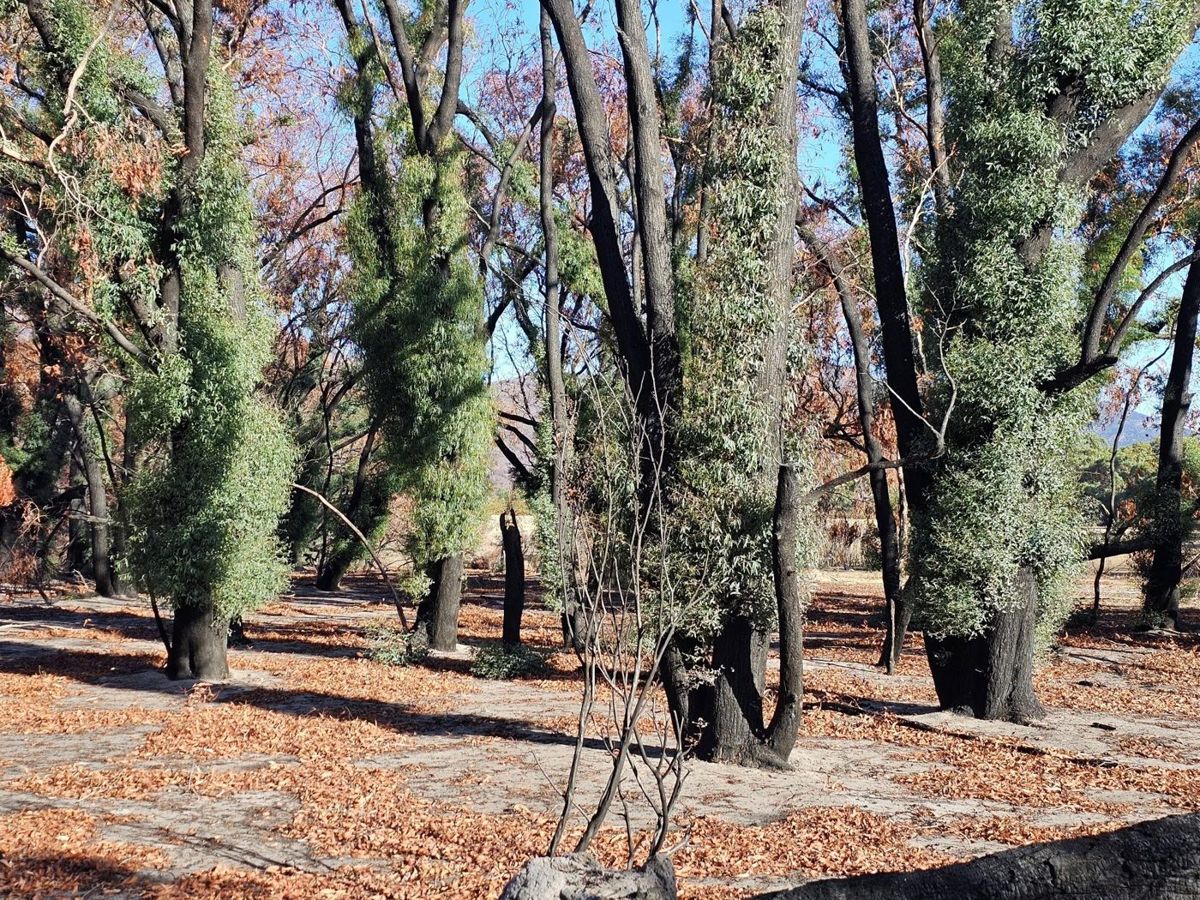 Two months
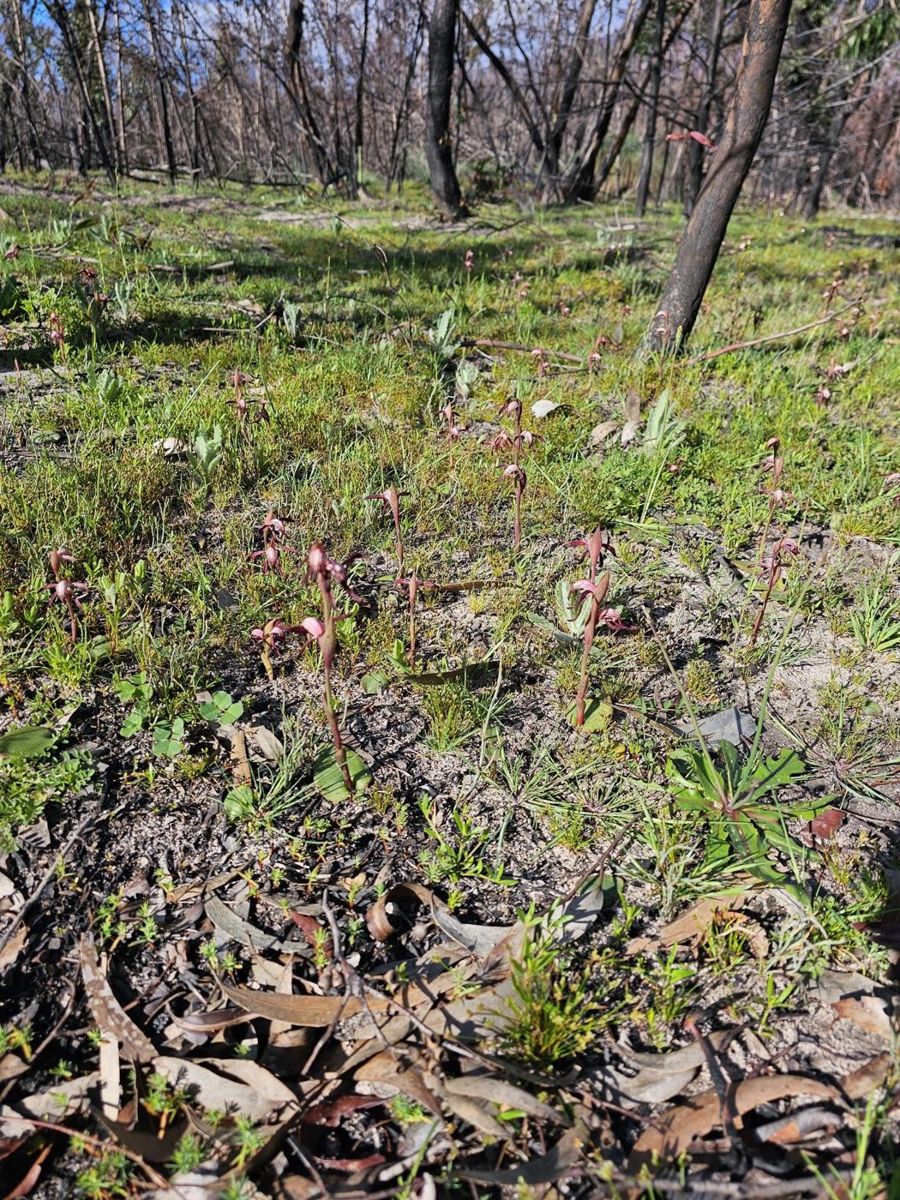 Spring
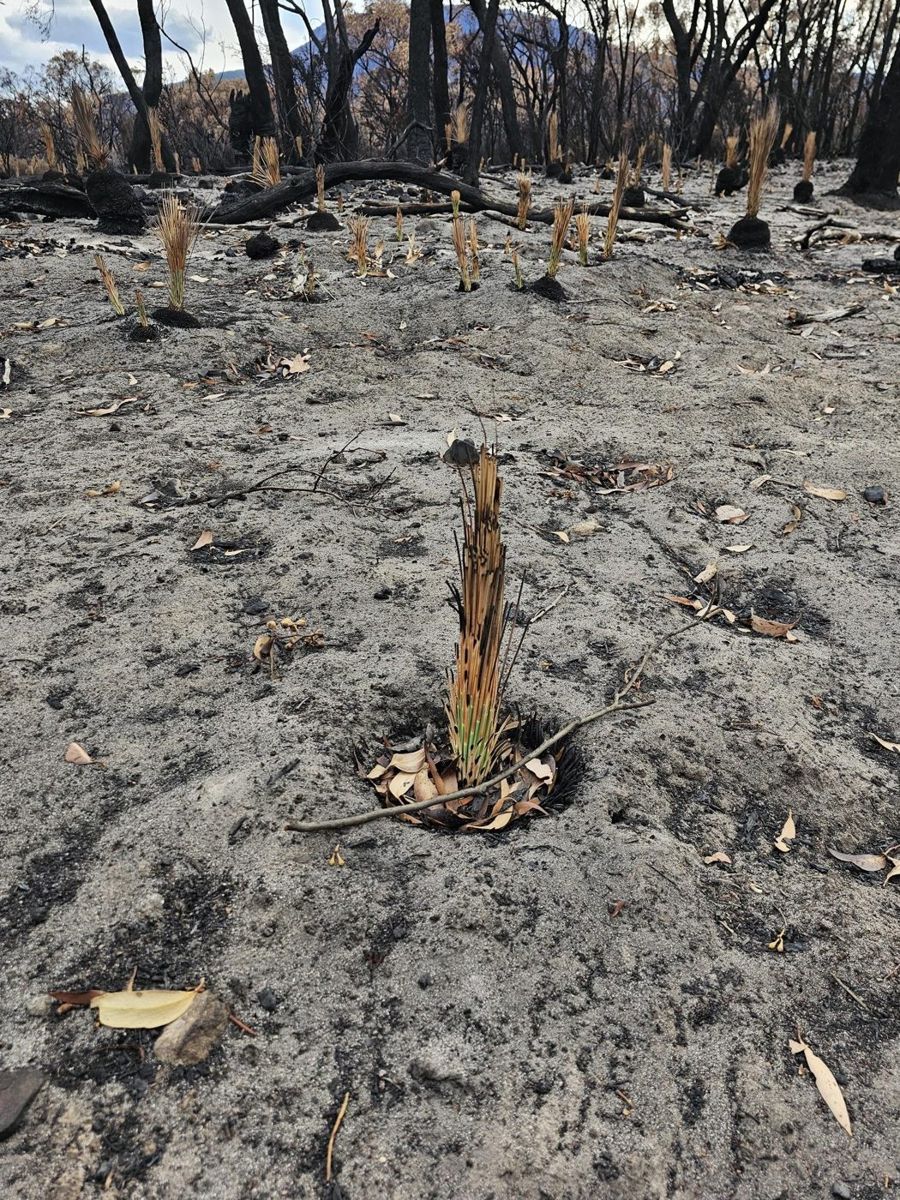
The same vantage point at two weeks, four weeks, two months and the following spring.
Source: landholder photo sequence, Pomonal district. Needs sign-off.
Your block in the landscape
A block that escaped when most of the country around it burnt, and so holds older bush than its surroundings, is a refuge: it may be sheltering animals with nowhere else to go, and it holds the seed and shelter the burnt country will recover from. A block that burnt when the bush around it didn’t, so it is younger than its surroundings, may recover quicker than one surrounded by more burnt land, because plants and animals have unburnt country close by to come back from. And where nearly everything in the surrounding landscape burnt, renewal may proceed more slowly.
If everything around you burnt and a patch of yours didn’t, protecting those smaller unburnt areas from weed invasion and grazing pressure is likely the most valuable thing you can do.
The reverse also holds: if your block burnt but is surrounded by long-unburnt country, your young regrowth may be the scarce stage, and protecting the rare species within the burnt area that pop up after the fire from weeds and grazing may be the most valuable thing you can do.
At the bottom of section 2.1, the Wimmera Bushfire Ecology Lookup Tool compares the growth stages of your block’s bush with the native bush within 5 km. It gives the share of each stage on your block and within 5 km, the share that is mature or older, and the nearest patch of mature or older bush of at least 5 hectares. Show the 5 km around your block on the map zooms out to show the surrounding bush coloured by growth stage, inside a dashed 5 km ring.
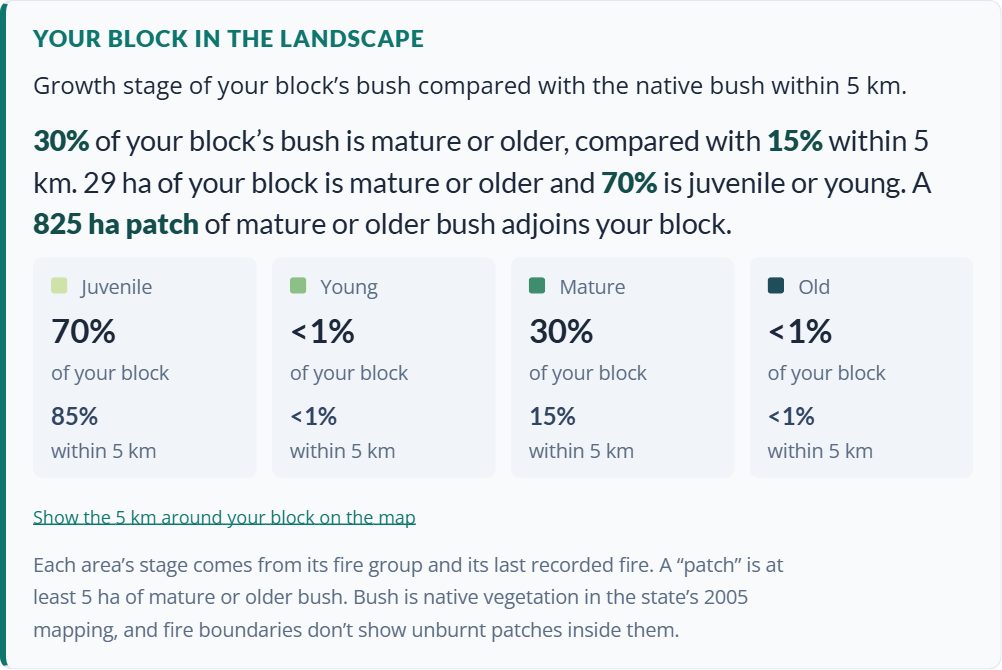
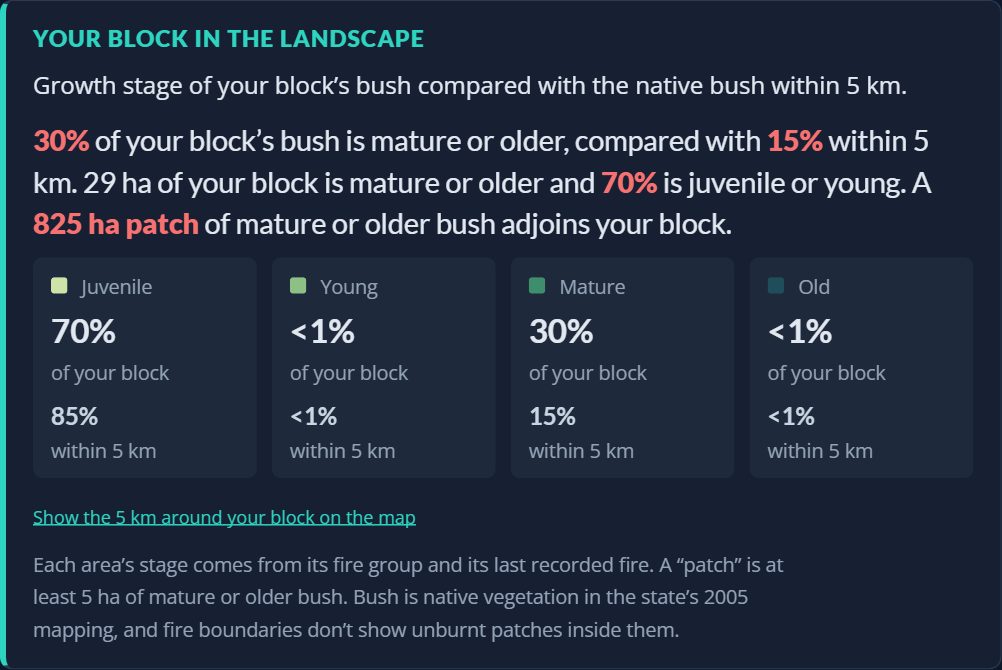
The 2025 fire burnt 79% of the native bush within 5 km, so most of the surrounding country is now juvenile (85%), and only 15% is mature or older. On the block it is 70% juvenile and 30% mature: proportionally twice as much older bush as the country around it.
The block’s 29 hectares of mature bush are not on their own, though. The tool finds they adjoin an 825-hectare patch of mature or older bush, so they are the edge of the largest refuge nearby rather than a lone island. For the burnt part of the block, that means shelter, seed and surviving animals are close by, and for the unburnt part, it means protecting it also protects the edge of something bigger.
Remember, there may be smaller unburnt patches inside a fire boundary that don’t show up in the state mapping.
This section now combines the old 1.5 (growth stages) and 2.1 (recovery timeline). The lookup tool screenshot still shows growth stages as section 1.5 on the Part 1 tab; retake it. The Your block in the landscape figures were read from the live tool on 3 October 2026; a screenshot of the 5 km growth-stage map could be added beside the card.
The mammal paragraph is new and draws on Hale and others (2022, 2016). The “What you see” table now uses the four stage names of the first table rather than its own five; worth an ecologist’s check of both.
The photo sequence above is from the example block. Its caption says the December 2024 fire, but the state record and the project’s site records give the 2025 Yarram Gap Road fire (January 2025). Confirm the date with the landholder.
The Inland Plains Woodland, Treed Swampy Wetland and Basalt Grassland rows fold Cheal’s five stages for each into the guide’s four (renewal and juvenility together as Juvenile, the last stage as Old). Worth an ecologist’s check.
Which term throughout — “young” or “adolescent”? Cheal’s formal stages for Grassy / Heathy Dry Forest run renewal, juvenility, adolescence, maturity, waning, senescence; Forby Forest has vigorous maturity and stasis instead of maturity and waning, so the two divisions do not even share a vocabulary. Recommendation: keep the plain set in the table and gloss the formal terms once in the glossary. The percentages above are attributed to La Trobe University work — that publication still needs pinning down.